Samsung
Samsung and Verizon Complete Successful ISAC Trial Over Virtualized Network at Global Sports Event
Samsung Electronics and Verizon have successfully completed an Integrated Sensing and Communication (ISAC) trial at a major international soccer fan event in Dallas, Texas, enabling real-time sensing-driven intelligence across a virtualized network. This landmark milestone represents one of the industry’s first practical implementations of a key technology for 6G, signaling how operators are…
Samsung Electronics and Verizon have successfully completed an Integrated Sensing and Communication (ISAC) trial at a major international soccer fan event in Dallas, Texas, enabling real-time sensing-driven intelligence across a virtualized network. This landmark milestone represents one of the industry’s first practical implementations of a key technology for 6G, signaling how operators are leveraging software-driven network architectures to create infrastructure that actively perceives, understands, and responds to their environment — moving beyond connectivity.
The groundbreaking field trial reinforces the value of the strategic partnership between Samsung and Verizon. Operating one of the world’s largest commercial virtualized networks, Verizon has led the charge in deploying a software-driven, AI-powered virtualized RAN (vRAN). This laid the foundation for a 6G-ready platform necessary to bring experimental use cases from concept to real-world validation — highlighting the flexibility of Samsung’s adaptable vRAN, which enables operators to introduce new capabilities like ISAC from day one by leveraging the commercial network they already run.
In the ISAC trial, Samsung integrated commercial AI-powered vRAN and vCore with an ISAC application, deploying them on its Network in a Server (NIS) — an end-to-end software-driven edge-AI platform that consolidates all network functions and accelerated compute into a single server. This allowed the ISAC trial to leverage connectivity from a 5G network without the need for any additional equipment.
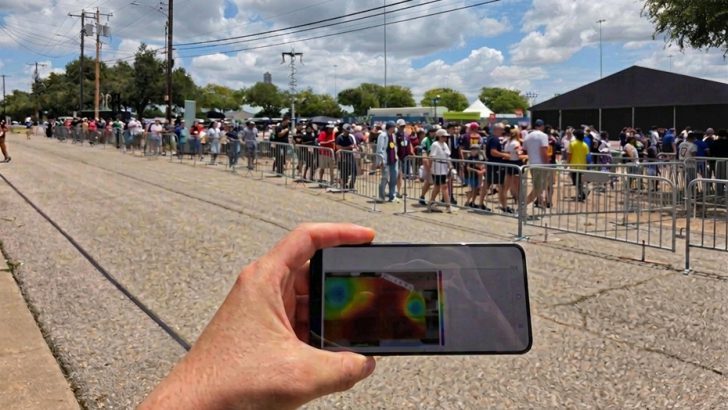
Acting as a sensing receiver, a CBRS1 radio unit using 40 MHz of spectrum mounted on a Verizon Cell-On-Wheels (COW) captured channel variations in transmissions from a commercial 5G device. Samsung’s NIS then analyzed this real-time data, utilizing the accelerated compute to extract actionable insights that are visualized as a crowd density heatmap that changes in near-real time to reflect people’s movements.2
Operating live at the event, the ISAC system used wireless signals as a sensing basis to automatically identify crowded areas within the venue, proving how sensing capabilities can enhance event management and the visitor experience across multiple stakeholder groups:
Attendees: Locate less congested food facilities and services, improving access and reducing wait times.
Event Organizers: Gain real-time visibility into crowd distribution and facility usage, enabling rapid resource deployment and operational optimization.
Security and Government Organizations: Detect emerging risks like overcrowding conditions, enabling early intervention to facilitate crowd control and prevent other public safety incidents.
The achievement reflects the synergy between Samsung’s commercial technologies and its advanced research in accelerating the path to 6G. The company’s efforts include its commercially proven vRAN software on the edge-AI platform NIS, and Samsung Research America’s (SRA) cutting-edge AI-driven ISAC solution.
“Verizon’s strategy has always been focused on building an intelligent, AI-native network that translates into meaningful real-world value for our customers,” said Yago Tenorio, Chief Technology Officer and Senior Vice President of Technology Development at Verizon. “Our early investments in flexible, software-driven vRAN architecture are paying off today, giving us the agility to engineer and trial groundbreaking 6G concepts like ISAC over our existing infrastructure. This field trial with Samsung proves that the network of the future will do far more than just transfer data — it will actively perceive and interact with its environment to transform venue management and public safety.”
“This successful ISAC trial underscores how Verizon’s decision to adopt a software-driven, AI-powered vRAN early on laid a solid foundation, positioning the company at the forefront of the 6G journey,” said Ji-Yun Seol, Executive Vice President and Head of Product Strategy, Networks Business at Samsung Electronics. “With this approach, forward-thinking operators like Verizon are unlocking untapped potential, spearheading the shift toward a new era where unprecedented services, devices, and use cases converge on next-generation networks.”
“This ISAC trial marks a significant leap forward in integrating AI-driven sensing capabilities into network infrastructure, showcasing the transformative potential of 6G technologies,” said Charlie Zhang, Executive Vice President at Samsung Research America. “By combining Verizon’s innovative approach with Samsung’s advanced vRAN solutions, we’ve demonstrated the practical application of ISAC in a real-world scenario to enhance safety, efficiency, and user experience. This collaboration reinforces our commitment to pushing the boundaries of what’s possible in next-generation wireless networks.”
As a founding member of the Verizon 6G Innovation Forum, Samsung is exploring new use cases to advance innovation, research initiatives, and the overall charter of the consortium. The company continues to work alongside visionary partners to deliver transformative technologies and drive the transition to 6G.
Samsung Networks has pioneered the successful delivery of 5G end-to-end solutions, including chipsets, radios, and cores. Through ongoing research and development, Samsung is driving the industry to advance 5G networks and paving the way for 6G and beyond with its market-leading product portfolio, from purpose-built RAN, vRAN, Open RAN, AI RAN, and cloud-native core to private network solutions and AI-powered automation tools (CognitiV NOS). The company currently provides innovative network solutions to mobile operators that deliver boundless connectivity to hundreds of millions of users worldwide.
Citizen Broadband Radio Service, a 150 MHz-wide band of the 3.5 GHz band in the United States. ︎
The crowd sensing demo measures crowd density, which is the number of people in a given area, at any given time. Individual users or objects are not identified. No information is obtained about the identity of the individuals. ︎
Originally published by Samsung. Read the full story at the source →